
Mulch spread at the right depth, decorative stone beds with block borders, and play areas edged and filled with gravel.
Get a free estimateTell us your number and we will call you back.
Mulch does real work in a bed. It slows evaporation, keeps the soil from swinging between hot and cold, and holds back weeds, which counts for a lot on the sandy, well-drained ground common around Smyrna. The University of Delaware recommends spreading it two to three inches deep. More is not better. Mulch should never touch a tree trunk, because bark that stays wet invites decay, insects and disease. Before the fresh layer goes down, we pull old mulch back from trunks and stems and check how much depth is already there.
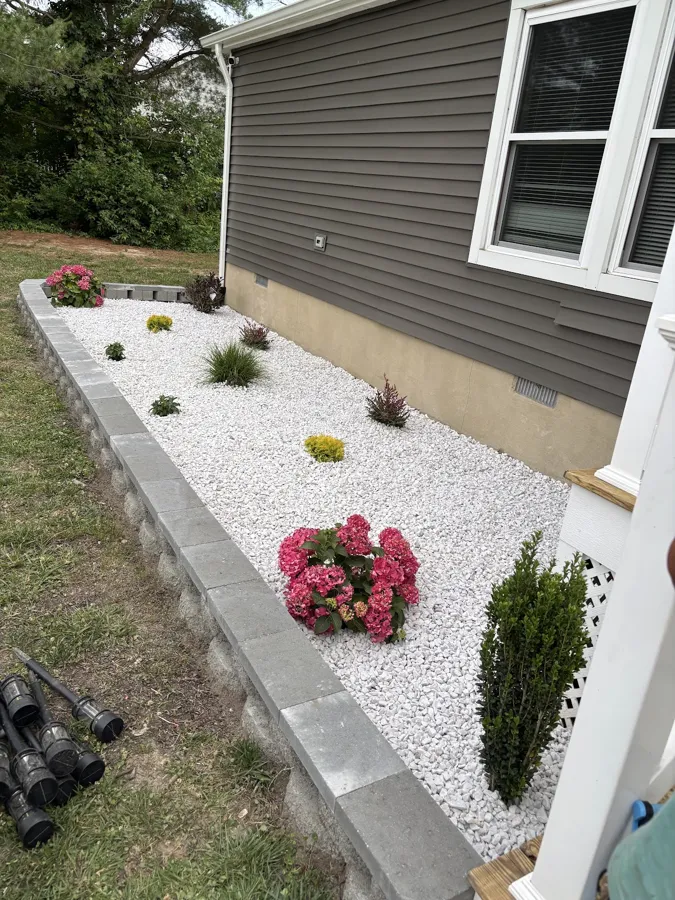
Decorative stone is the other option, and it suits beds where you want a clean look that does not need a fresh layer every spring. A stone bed starts the same way a mulch bed does: old growth cleared, the ground leveled and shaped, and an edge set to hold everything in. Along a house, a gray block border gives white stone a firm edge and keeps it from spilling into the lawn, where a loose rock can end up in front of the mower. Shrubs and flowers get planted before the stone goes in.
Play areas need more depth than any flower bed. The Consumer Product Safety Commission's home playground handbook calls for at least nine inches of loose fill such as pea gravel or sand under equipment up to five feet high, or wood mulch under equipment up to eight feet. It notes that about twelve inches of fresh fill settles to roughly nine over time, and that the surfacing should reach at least six feet past the equipment on every side. A solid border around the area keeps that fill where it belongs.
Mulch breaks down over time, which is part of what it does for the soil. Before adding more, we check the depth: if two to three inches are still there, a light refresh for color is plenty. Piling new mulch on old year after year is how beds end up too deep around the plants.
It depends on the bed. Mulch adds organic matter as it breaks down and suits shrubs and flowers that like moist ground. Stone stays put for years without a fresh layer and gives a clean, bright edge along a house. Plenty of yards use both, mulch in the planting beds and stone along the foundation.
The federal home playground handbook calls for at least nine inches of pea gravel or sand under equipment up to five feet high, reaching six feet past the equipment on all sides. Fresh fill settles, so starting closer to twelve inches helps. A border keeps the gravel from kicking out or washing away in heavy rain.
Mowing and edging, landscaping and new beds, block retaining walls, decorative stone and mulch, brush removal, and seasonal cleanups. If it's outside, just ask.
Yes. We dig out and level the base, set the block, and backfill so the wall stays straight. Then we can finish the bed with stone, mulch, and plants.
Yes. Snow removal is on our sign right next to mowing and landscaping. We clear driveways, walks and steps after a storm. Call or text (302) 244-2121 before the first snow so we know where you are.
Smyrna and Clayton, plus Cheswold, Kenton, Leipsic, Hartly, Townsend, Odessa and Middletown. If you are a little further out, call or text (302) 244-2121 and ask.
Yes. Small tree removal and brush removal are both on our sign. We cut out small trees, thick brush and vines and haul it all away. A big tree near the house or the power lines is a job for a tree service, and we will tell you if yours is one.
Yes. Clippings, leaves, brush and old mulch leave with us, and we blow off the walks and the driveway before we go.
Yes. We edge play areas with a border and fill them with fresh gravel, like the playset area in our gallery.